General information only, not personalized financial advice. Disclaimer.
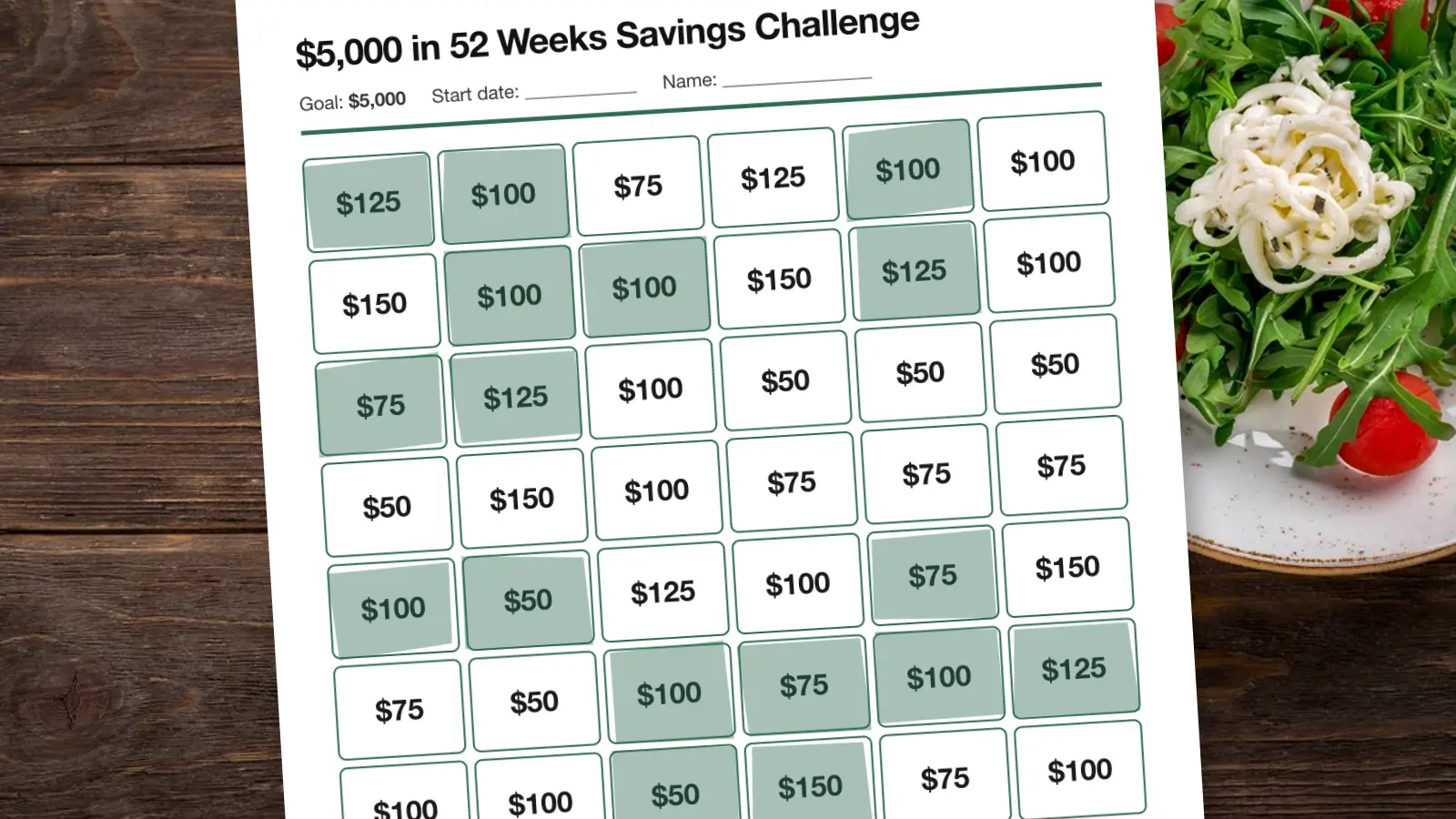
The $5,000 savings challenge is simple: save $5,000 in 52 weeks by shading one square on a chart every week. The trick that makes this version work is that the squares aren’t all the same. Some are $50, some are $150, and you pick whichever one fits the week you’re having.
That flexibility is why people finish it. A rigid “$96 every Monday” plan falls apart the first time the car needs tires. A pick-any-square chart bends.
Quick math: $5,000 ÷ 52 weeks = about $96 a week, $417 a month, or $13.70 a day.
How the $5,000 challenge works
- Print the chart. Our free tracker has 52 squares that add up to exactly $5,000.
- Each week, pick one square and move that amount into your savings.
- Shade it in. Seeing the chart fill up is the whole point — it’s weirdly motivating.
- After 52 squares, you have $5,000.
Here’s what’s on the chart:
| Square value | How many | Subtotal |
|---|---|---|
| $50 | 8 | $400 |
| $75 | 12 | $900 |
| $100 | 18 | $1,800 |
| $125 | 8 | $1,000 |
| $150 | 6 | $900 |
| Total | 52 | $5,000 |
A smarter way to pick your squares
You can choose squares at random, but people who finish usually follow a pattern:
- Payday weeks → big squares. Knock out a $125 or $150 square the day your paycheck lands, before the money has a chance to disappear.
- Bill-heavy weeks → small squares. Rent week, insurance week, birthday week: grab a $50.
- January → front-load. Motivation is highest in the first month. If you can clear four or five $100+ squares in January, the rest of the year feels lighter.
- Windfalls → bonus squares. Tax refund, holiday bonus, money from selling stuff? Shade two or three squares at once.
Where to keep the money
Keep it out of your everyday checking account, or it will quietly get spent. Common options:
- A separate savings account at a different bank from your checking (harder to transfer back on impulse).
- A high-yield savings account at an FDIC-insured bank, so the money earns a little interest while it sits.
- Cash envelopes, if you’re paid in cash — but count it often and keep it somewhere safe.
We don’t recommend specific banks or investments. The goal of this challenge is simply to build a cash cushion, not to grow money in the market.
Finding the $96 a week
This is the honest part. $5,000 has to come from somewhere. A few places that commonly free up $20–$40 a week each:
- One fewer takeout night a week — often $25–$40 saved for a family.
- Cancel one streaming service and rotate them instead of paying for all at once.
- Meal plan around what’s on sale (see our guide to cutting your grocery bill).
- Call your phone and internet providers once a year and ask for a better rate.
- Sell three things you don’t use each month on Facebook Marketplace or a local selling app.
Stack two or three of those and the weekly square starts to look a lot less scary.
Can’t swing $5,000? Pick a smaller version
There’s no prize for picking a goal that makes you quit in March. Try one of these instead:
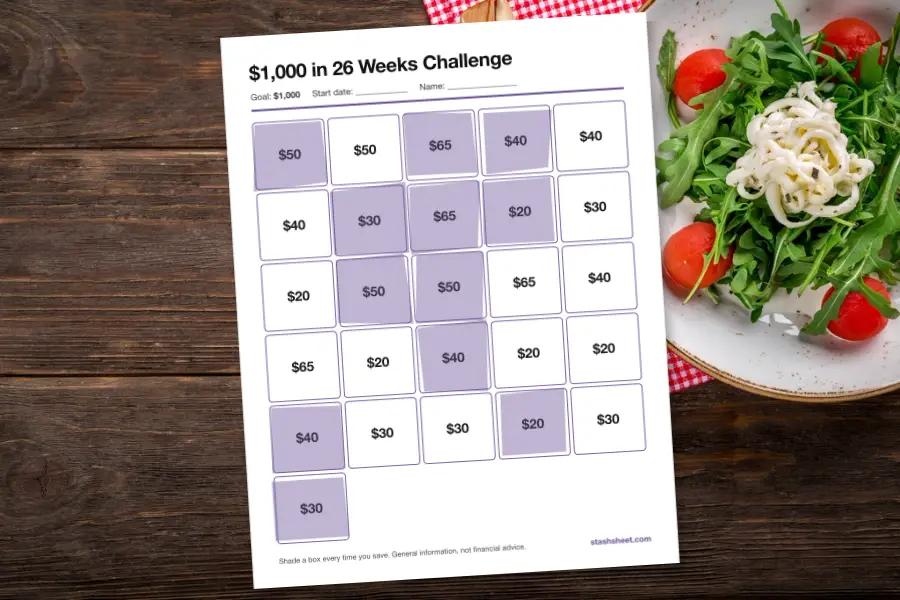
- $1,000 in 26 weeks — squares from $20 to $65.
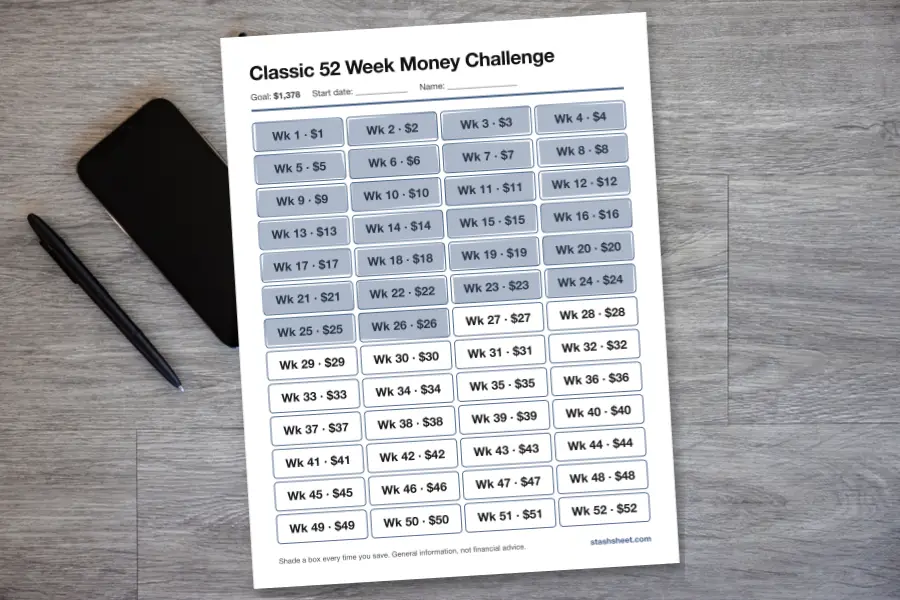
- The classic 52-week challenge — $1 in week one up to $52, for $1,378 total.
- The 100 envelope challenge — $5,050, but you can do half the envelopes for about $1,275.
Finish a small one, then level up. That’s how the habit sticks.
What to do when you fall behind
Almost everyone falls behind at some point. Don’t restart — resume.
- Pick the smallest square left and shade it this week.
- Add an extra $5 or $10 a week until you catch up.
- If you’re more than a month behind, stretch the end date. Finishing in 60 weeks still means $5,000.
Make it a family or couples challenge
Two people doing half the chart each is a great way to hit $5,000 without either person feeling squeezed. Kids can “own” a few $50 squares by skipping a treat or selling old toys — it’s a sneaky money lesson.
Prefer your phone? Track every week with the free interactive 52-week challenge tracker — it saves your progress on your device.
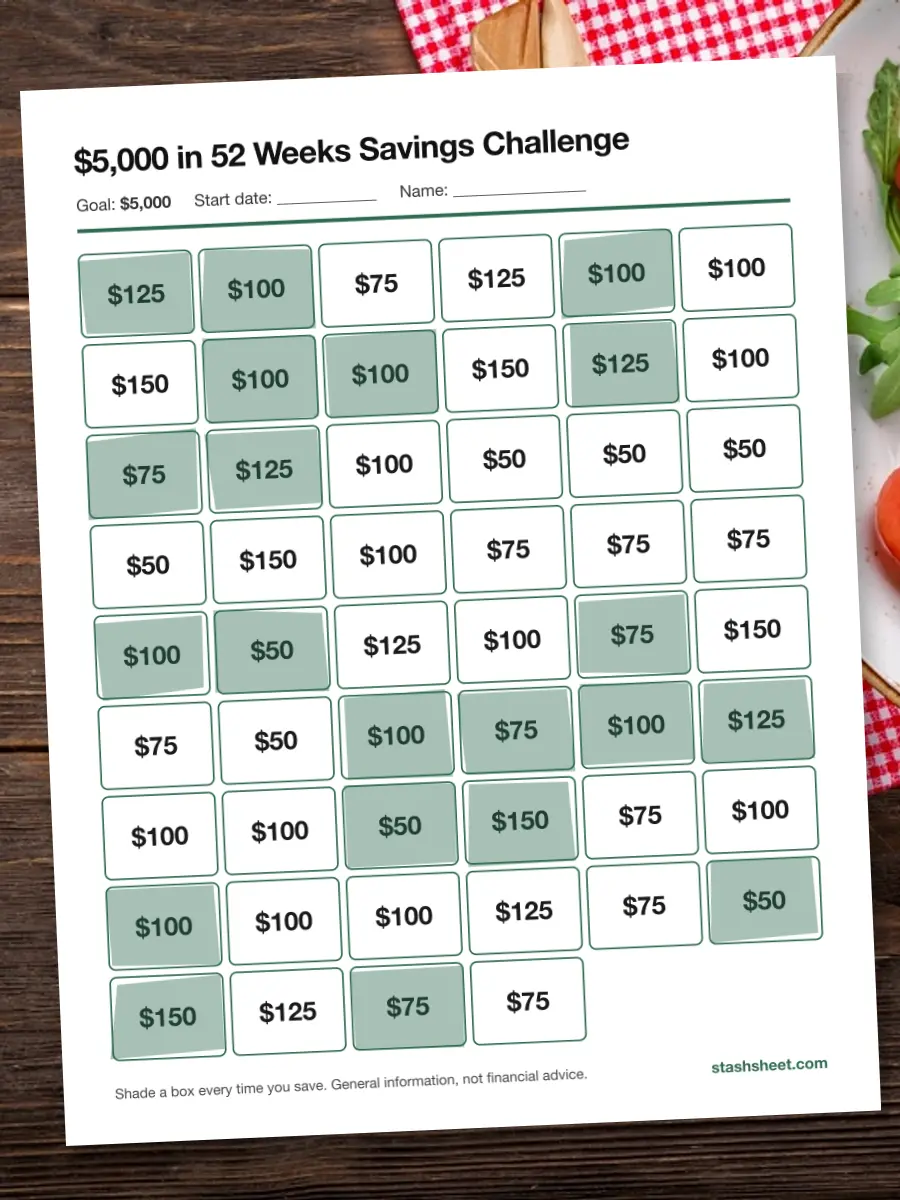
$5,000 in 52 Weeks Savings Challenge
Shade one square each week. Every square is $50–$150, so you can pick a small one on tight weeks and a big one after payday. Free one-page PDF, no email needed.
Download free PDF PreviewFrequently asked questions
How much do I need to save per week to reach $5,000 in a year?
On average about $96 a week, or roughly $417 a month. The printable chart breaks it into 52 squares between $50 and $150 so you can save less on tight weeks and more on good ones.
Can I do the $5,000 challenge biweekly?
Yes. If you're paid every two weeks, shade two squares each payday. You'll still finish all 52 squares in 26 paydays.
What if I miss a week?
Nothing breaks. The squares aren't tied to dates, so just pick a smaller one next week or add a mini catch-up square when you get a refund or a bonus.
Is $5,000 in a year realistic?
It depends on your income and costs. For many households it means finding about $14 a day. If that's too much right now, start with the $1,000 in 26 weeks tracker and move up.
Sources
- CFPB: Looking for an easy way to save money? Make it automatic
- FDIC: Understanding deposit insurance
- Investor.gov (SEC): What is compound interest?
These are official, free resources. This article is general information, not personalized financial advice — for decisions about your own money, talk to a licensed professional or a nonprofit counselor.